

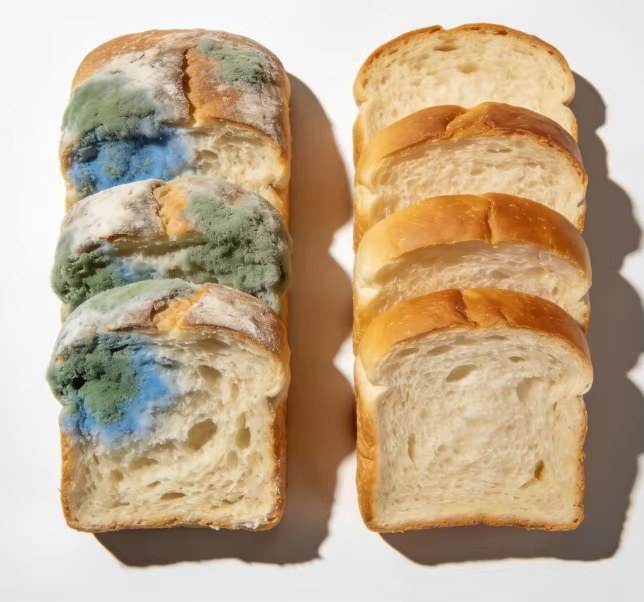
Calcium propionate works well in low-pH rye sourdough bread — acidity is exactly what activates it — but the crumb mold that persists in rye bread usually has a different name: Penicillium roqueforti, a rye specialist that tolerates and sometimes thrives on propionate. The practical program is therefore three-layered: use the sourdough's own acids to keep the propionate in its active form, dose at the level the acid system lets you work with, and validate against the molds that actually spoil rye bread rather than generic plate counts.
The sections below set out how propionate behaves in a low-pH rye system, what dose to trial, where the clean-label line sits in Europe, and how to run a validation that survives a variable sourdough process and an EAEU market submission.
Why does mold still grow when the acidity is already high?
Low pH is the propionate's friend and the baker's shield, but it is not a complete wall. The undissociated propionic acid fraction — the form that enters mold cells and disrupts their metabolism — rises as pH falls, which is why rye sourdough conditions favor the preservative. Controlled studies simulating sourdough rye conditions found that a propionate dose at the low end of the flour basis inhibited most tested fungi for the full trial window. The exceptions are what the validation panel is for: certain rye-associated molds, most notably Penicillium roqueforti, showed resistance and even stimulation at high water activity, and a couple of storage-mold species tolerated the treatment as well.
Two conclusions follow for the QA file. First, crumb mold in an acidic rye loaf is not evidence that propionate has failed chemically; it points to either a resistant species or a moisture path the dose cannot cover. Second, the validation panel has to include the organisms that actually spoil rye bread, because a generic mold screen can pass while the real spoiler walks through.
How do propionate and sourdough acids work together?
The sourdough's lactic and acetic acids do three jobs that propionate builds on. They lower the pH, which keeps more of the added propionate in its active form. They contribute their own antifungal activity — acetic acid in particular is the stronger antifungal of the two — through the same undissociated-acid mechanism. And they partially degrade phytate in the rye flour, which frees minerals and supports the fermentation itself. Controlled pairings of the acids showed additive antifungal effects, and trials with acetate-producing sourdough cultures cut the propionate dose needed for a shelf-life target dramatically.
For the baker, the working conclusion is that the sourdough process is part of the preservation system. A leaner, faster sourdough that skips the acetic phase hands back the shelf life the preservative dose was supposed to buy, and the validation has to run on the process the plant actually performs rather than the one the recipe describes.
What dose should a low-pH rye formula trial?
Acidity lets the dose start lower than a wheat sandwich bread would need, because more of each gram arrives in the active form. A sensible trial ladder for a genuinely low-pH rye runs a low, middle, and upper level across the flour basis, with the low level often enough for moderate shelf-life targets and the upper level reserved for packaged products with hard mold-free requirements. Three ceilings bound the ladder:
- The regulation ceiling. Permitted propionate levels in bread are set per market and category, and the specification should name the strictest limit the product will meet and stay inside it.
- The sensory ceiling. Propionate carries a flavor cost, and rye bread's own acidic profile changes how noticeable that cost is. The sensory panel decides the top of the range, not the label.
- The effectiveness ceiling. Past the validated range, each increment buys less shelf life — and against a resistant species like P. roqueforti, more powder may buy nothing at all.
Fermentation impact belongs in the same trial. Propionate is far gentler on baker's yeast than sorbate, which is why it is the default in yeasted breads, but a sourdough runs on mixed cultures and the test should record proof time and acidity development alongside the mold readings, so a dose that quietly slows the ferment does not sneak through on mold numbers alone.
Where does propionate sit on a clean-label rye loaf?
European rules permit propionates in bread and require the declaration — functional class plus name or E number — so the legal position is straightforward. The commercial position is more delicate: a loaf whose front of pack sells sourdough and rye flour, and whose ingredient list declares a preservative, invites the question of why the sourdough was not enough. Retail buyers in premium bread segments treat that combination as a positioning signal, not a technical detail.
The practical paths away from the conflict are process-based rather than label-based: a longer or more acetic fermentation, tighter post-bake hygiene, packaging that manages condensation, and slicing hygiene all move the mold-free clock. The honest comparison for a customer asking for a preservative-free loaf with equal shelf life is a side-by-side trial on the same process — the trial designs on the bakery applications page give that comparison a structure — and it should be run as one, because the answer is frequently that the two loaves will not match, and the customer deserves that answer early.
How do you validate shelf life on a variable sourdough process?
Validate the system, not a batch. The design that holds up under review tests the weakest fermentation condition still inside the plant's specification — the shortest ferment, the warmest dough, the least acetic starter — because a claim built on the average batch fails on the worst one. Packs from that worst-case run sit under the distribution conditions the market actually imposes, and the first-mold-day reading on any pack sets the claim.
Batch-to-batch variation is part of the data, not noise to average away: recording starter acidity and ferment endpoint per trial batch connects the shelf-life result to the process parameters a production manager can hold. Where the plant cannot hold a parameter tightly, the validation either widens the safety margin or the process gets fixed first — the shelf-life claim sits on top of process control, never instead of it.
What records support an EAEU submission?
The customs union's technical regulation on food additives governs which propionates are permitted and at what levels, so the submission file starts from the regulation's entry for the specific salt and category. The records that support the level itself come in two groups:
- Regulatory eligibility. The additive's authorization entry, the product category, and the applicable maximum, cited from the technical regulation.
- Analytical confirmation. A validated method for propionate in the rye-bread matrix — the AOAC interlaboratory study on propionic and sorbic acid in rye bread is the classic reference for method fitness — plus your own trial results showing the residual level lands inside the permitted window.
The trial records that feed the file are the same ones the plant keeps anyway: dose schedule, ferment parameters, pack format, storage conditions, first-mold-day readings, and the sensory notes that bounded the top of the dose range. Together they show a submission reviewer both that the level is legal and that it is controlled.
FAQ
Does acidity make propionate unnecessary in rye bread?
Acidity makes propionate more effective, not redundant. The sourdough acids and the added preservative work as a system, and the resistant rye spoilers are exactly the organisms the acid alone does not stop.
Why does crumb mold appear while the crust stays clean?
Crumb carries higher water activity and the slices expose fresh surface; the resistant species favor exactly that habitat. Pack condensation after cooling feeds the same spots.
Should the dose follow the rye share in a mixed loaf?
Dose follows the whole formula's pH, water activity, and shelf-life target. A mixed rye-wheat loaf with a mild ferment behaves like a wheat-type loaf; a true sourdough rye behaves like a rye-type loaf.
Does higher rye crumb moisture change the calculation?
It raises water activity, which shortens the mold-free clock at any dose and narrows the gap between dose levels. The validation runs on the commercial moisture content, not the recipe's.
Can a preservative-free loaf match a preserved one?
Sometimes, with a longer acetic fermentation and tight process control — but the side-by-side trial decides it, and the answer is frequently no. The customer deserves that answer with data rather than a promise.
What single record prevents the most rework in an EAEU submission?
The method-fitness reference for propionate in rye bread. An analyst reviewing residual results will ask how they were measured, and the interlaboratory study plus your own method record answers before the question is asked.
Next step
If you are specifying propionate for rye or mixed bread programs headed to EAEU markets, the calcium propionate page lists the grades and documentation behind the dose validation, and the Russia & CIS market page summarizes the regional logistics and document support. The customs union's technical regulation on food additives is published through the EAEU official document portal.


